The Official Blog of Morningside Nannies
 Working as a nanny is personal by nature. You spend your days in someone’s home, caring for the people they love most. Over time, you may become incredibly close to the family you work for—and they may genuinely consider you part of their family.
But there is an important distinction that professional nannies need to remember: your nanny family is also your employer.
At Morningside Nannies, we encourage nannies and families to develop warm, trusting, long-term relationships. While doing so, maintaining appropriate professional boundaries is an important part of building and protecting those relationships. One boundary that can become complicated very quickly involves asking your employer for a pay advance or personal loan.
Your Employer Is Not Your Bank
Unexpected expenses happen to everyone. A car breaks down, a bill is higher than expected or your family experiences an emergency. When you have a close relationship with your employers, it can be tempting to ask them to advance your next paycheck—or even several weeks of pay.
While an employer may agree to help, making the request can put them in an uncomfortable position.
Your employer hired you to provide professional childcare services in exchange for agreed-upon compensation. They did not enter the employment relationship expecting to become a source of personal financing.
Even when the request feels small to you, it may change the dynamic of the relationship.
A Pay Advance Can Create an Uncomfortable Power Dynamic
One of the healthiest foundations for a nanny-family relationship is mutual respect. The nanny provides professional services, and the family pays the nanny according to the terms of the employment agreement.
Borrowing against future wages can blur that relationship.
If an employer advances you $500, $1,000, or several weeks of wages, suddenly you aren’t simply working your regular schedule and receiving your regular paycheck. You are working hours for money you’ve already received.
That can feel uncomfortable for both sides.
What happens if you need to leave the position unexpectedly or the family needs to terminate employment? What if there is a disagreement about how much is still owed or if you need another advance before the first one has been repaid?
A simple request can quickly become a complicated employment issue.
Repeated Requests Can Raise Concerns About Reliability
Nannies are trusted with tremendous responsibility. Parents depend on their nanny not only to care for their children, but also to arrive on time, maintain confidentiality, exercise sound judgment, and handle responsibilities independently.
When an employee repeatedly asks for advances, employers may begin to worry about financial instability and whether it could eventually affect the job.
That doesn’t mean someone experiencing financial hardship is irresponsible. Life happens, and emergencies happen. But from an employer’s perspective, repeated requests for early wages may create concerns about boundaries, judgment, or whether the arrangement is sustainable.
You don’t want your employer wondering each payday whether another request for money is coming.
Being “Part of the Family” Doesn’t Eliminate Professional Boundaries
This is one of the most important lessons for career nannies.
A family can love you.
They can invite you to birthday parties.
Their children can adore you.
You can travel together, celebrate milestones together, and remain friends long after the employment relationship ends.
And they are still your employer.
Being treated like family should never require abandoning professional boundaries. In fact, the strongest long-term nanny relationships I’ve seen are typically the ones where both sides understand that warmth and professionalism can coexist.
Advances Can Become Especially Complicated When Employment Ends
Imagine that your employer advances you two weeks of pay and, a few days later, circumstances change.
Perhaps you receive another job opportunity or the family’s childcare needs change. Maybe the employment relationship simply isn’t working.
Now the family may be trying to determine how much money must be repaid, whether it can legally be deducted from wages, and how to handle the outstanding balance.
What began as an act of generosity can become a source of frustration or conflict.
This is one reason it is generally better to keep personal borrowing separate from the employment relationship whenever possible.
An Advance Should Be the Exception, Not the Plan
There may be rare circumstances where a nanny experiences a genuine emergency and an employer voluntarily offers assistance. That’s different from routinely relying on an employer to provide early access to wages.
If you find yourself regularly needing your paycheck before payday, it’s worth looking at the bigger financial picture.
Consider whether you need to adjust your budget, increase your guaranteed hours, pursue a higher-paying position, add occasional babysitting work, build an emergency fund, or explore other legitimate financial resources available to you.
The goal should be to create a situation where receiving your paycheck on the agreed-upon payday works for your financial needs.
What If You’re Having Trouble Making Ends Meet?
If your compensation or guaranteed hours are no longer sufficient, that’s a conversation worth having—but it’s a different conversation than asking for an advance.
You might say:
“I’d like to schedule some time to talk about my compensation and guaranteed hours. I’d like to discuss whether there is an opportunity to revisit my compensation package.”
Your employer may or may not be able to accommodate a change, but you’re addressing the underlying issue professionally rather than repeatedly borrowing against future wages.
Likewise, if you believe you are being paid late or incorrectly, that’s not a request for an advance. You are entitled to receive the wages you’ve already earned according to your agreed-upon payroll schedule, and you should address payroll problems promptly.
Protect the Relationship You’ve Worked Hard to Build
Your professional reputation matters.
The nanny community is smaller than you may realize, and strong references can play an important role throughout your career. You want former employers to describe you as dependable, professional, trustworthy, responsible, and respectful of boundaries.
Before asking an employer for a pay advance, consider whether there is another way to address the financial need.
A wonderful nanny-family relationship can absolutely be warm, loving, and personal. But maintaining healthy professional boundaries is part of what allows that relationship to remain strong.
At Morningside Nannies, we want the nannies we represent to build careers—not simply find their next job. Part of being a career nanny is learning how to navigate the unique relationship between working in someone’s home and remaining a professional employee.
Your nanny family may care deeply about you, but they are still your employer. Protecting that boundary protects you, the family, and the professional relationship you’ve worked hard to build.
— Michelle LaRowe, Executive Director, Morningside Nannies
Posted in
Advice for Nannies,
Advice for Parents |
Comments Off on Nannies! Stop Asking for Pay Advances
Thank you to our friends at GTM for providing this update.
Every year the IRS issues a standard mileage rate for the year. As a result of recent increases in the price of fuel, the IRS has made a midyear adjustment to the optional standard mileage rates used to calculate the deductible costs of operating an automobile for business, medical or moving expense purposes. Typically, the rates are adjusted annually, with a new rate taking effect Jan. 1 each year. This is the first midyear adjustment since 2022.
The revised standard mileage rates set forth in
Announcement 2026-11, published July 13, 2026, apply to deductible transportation expenses paid or incurred for business, medical or moving purposes
on or after July 1, 2026. The new rate applies to mileage allowances that are paid both to an employee on or after July 1, 2026, and transportation expenses paid or incurred by the employee on or after July 1, 2026.
During this period, the revised standard mileage rates are:
- 76 cents per mile for business travel; and
- 23.5 cents per mile for medical and moving expenses.
To read the entire article, provided by GTM Tax and Payroll, click here.
Posted in
Advice for Nannies,
Advice for Parents |
Comments Off on IRS Raises Mileage Rates for Second Half of 2026

By Michelle LaRowe, Executive Director of Morningside Nannies
One of the first questions I ask families when they contact Morningside Nannies looking for a nanny is:
“What do you really need help with?”
Most parents answer, “Everything.”
And honestly, I understand why.
Today’s families aren’t just looking for childcare. They’re trying to balance demanding careers, school schedules, extracurricular activities, household responsibilities, pets, appointments, errands, and somehow still find time to enjoy being a family.
The good news? There isn’t just one solution.
At Morningside Nannies, we help families hire professionals for several distinct household roles. Understanding the difference can help you hire the right person—and set everyone up for success.
The Professional Nanny
A nanny’s primary responsibility is the care, safety, and development of the children.
Professional nannies do much more than supervise children. They become trusted caregivers who create enriching experiences, establish routines, encourage learning, support developmental milestones, transport children to activities, and partner with parents in raising happy, confident kids.
Typical nanny responsibilities include:
- Providing attentive, engaging childcare
- Planning age-appropriate educational activities
- Supporting developmental milestones
- Preparing children’s meals
- Transporting children to school and activities
- Managing children’s laundry and bedrooms
- Maintaining children’s toys and play areas
- Communicating with parents about the children’s day
While many nannies are happy to help when time allows, their priority should always remain the children.
If your biggest need is childcare, a nanny is likely the right fit.
The Family Assistant
A Family Assistant focuses on everything that keeps the household running smoothly.
Think of this role as providing a daily household reset.
Instead of spending your evenings catching up on chores, your Family Assistant helps ensure your home is organized, functional, and ready for the next day.
Daily Household Reset Responsibilities
A Family Assistant may:
- Keep kitchens and common areas tidy by wiping counters, loading and unloading the dishwasher, taking out trash, organizing recycling, and breaking down delivery boxes.
- Vacuum, sweep, and Swiffer high-traffic areas between professional housekeeping visits.
- Wash, dry, fold, and put away laundry, with occasional steaming or ironing.
- Organize closets, pantries, bathroom vanities, mudrooms, and other household spaces.
- Prep ingredients for dinner by washing and chopping produce or assembling meal kits.
- Walk pets and coordinate grooming and veterinary appointments.
Weekly and Ongoing Household Support
Family Assistants often:
- Maintain grocery and household supply inventories.
- Grocery shop, run errands, process returns, and put deliveries away.
- Schedule and oversee contractors and home maintenance appointments.
- Assist with seasonal decorating, holiday shopping, and gift wrapping.
- Coordinate vehicle maintenance, including gas, oil changes, inspections, car washes, registration renewals, and tire rotations.
- Complete miscellaneous household projects that help the family stay organized.
A Family Assistant is not a housekeeper.
Most of our Family Assistant clients already have a professional cleaning service. The Family Assistant bridges the gap between cleanings by keeping the household running efficiently day after day.
The Household Manager
If the Family Assistant works in the household, the Household Manager works on the household.
A Household Manager oversees the day-to-day operation of the home, often supervising staff, coordinating schedules, managing vendors, and ensuring every moving part of the household operates efficiently.
Responsibilities may include:
- Managing household staff
- Scheduling maintenance and repairs
- Overseeing household budgets and expenses
- Coordinating calendars and travel
- Planning family events and holidays
- Managing vendors and contractors
- Supervising home projects
- Creating household systems and procedures
Many Household Managers perform very little childcare. Their role is operational and administrative, making them ideal for busy executives, physicians, entrepreneurs, and families with multiple employees.
The Nanny/Family Support Specialist
One of the fastest-growing positions we recruit for is the Nanny/Family Support Specialist.
This hybrid role combines exceptional childcare with meaningful household support while the children are at school, napping, or otherwise occupied.
Rather than sitting idle during downtime, this professional uses available time to complete household tasks that make life easier for the entire family.
A Nanny/Family Support Specialist may spend the morning:
- Completing laundry.
- Tidying common areas.
- Running errands.
- Preparing dinner ingredients.
- Grocery shopping.
- Organizing closets or pantries.
- Walking the family dog.
- Receiving deliveries.
Then transition seamlessly into:
- School pickup.
- Homework help.
- Driving to extracurricular activities.
- Preparing children’s dinner.
- Supervising baths and bedtime routines.
- Creating engaging afternoon activities.
Because household responsibilities are completed before the children arrive home, evenings become less hectic and more enjoyable for everyone.
This role is especially popular with families whose children are school-aged and no longer require full-time daytime childcare but whose parents still need dependable afternoon care and household support.
Which Role Is Right for You?
Ask yourself this simple question:
What causes the most stress in your daily life?
If it’s childcare…
Hire a Nanny.
If it’s keeping your home running…
Hire a Family Assistant.
If you’re managing multiple staff members, vendors, and a complex household…
Hire a Household Manager.
If you need both exceptional childcare and someone to help your household run more smoothly…
A Nanny/Family Support Specialist may be exactly what you’re looking for.
The Right Hire Changes Everything
One of the biggest mistakes families make is trying to squeeze multiple full-time jobs into one position without clearly defining expectations.
The most successful placements happen when the role matches the family’s actual needs, expectations are clearly communicated, and both the family and employee understand what success looks like.
At Morningside Nannies, we take the time to understand your family’s lifestyle before recommending candidates. Whether you need a nurturing nanny, an organized Family Assistant, an experienced Household Manager, or a versatile Nanny/Family Support Specialist, we’ll help you find the professional who makes your life easier—and your home run more smoothly.
Because when the right support is in place, families don’t just survive the week—they enjoy it.
Posted in
Advice for Nannies,
Advice for Parents,
All About Nannies,
Houston |
Tagged
nanny |
Comments Off on Nanny vs. Family Assistant vs. Household Manager vs. Nanny/Family Support Specialist: Which Role Is Right for Your Family?

At Morningside Nannies, we know that a great interview can open doors to incredible opportunities. Even the most experienced nanny can miss out on a wonderful position if they are not prepared to present themselves professionally and confidently during the interview process.
That’s why we were excited to have contributed to a new free online course created by Tonya Sackowicz at Newborn Care Solutions, Interviewing Professionally, alongside agency leaders and industry professionals from across the country. In this course, we share some of our favorite interview tips, including how to prepare effectively, communicate your strengths, avoid common interview mistakes, and leave a lasting positive impression with us and with families.
A successful interview isn’t about having all the right answers—it’s about showcasing your experience, professionalism, and personality in a way that helps families see the value you bring to their home. As soon as you first connect with an agency or parent, you are being evaluated to determine if you are the right match. Stand out by ensuring you present your best self.
Whether you’re actively job searching or simply want to sharpen your professional skills, we encourage you to take advantage of this free resource. Investing a little time in improving your interview skills can make a significant difference in your career.
You can access the course here:
Interviewing Professionally (Free Course)
We hope you’ll take a few moments to complete this free course and put these strategies into practice during your job search. With a little preparation and some new nanny knowledge, your next great opportunity may be just one interview away.
Posted in
Advice for Nannies |
Tagged
nanny job |
Comments Off on Free Interview Resource for Nannies
 By Michelle LaRowe
When I first began working as a nanny more than three decades ago, I didn’t set out thinking, this will be my career. Like many, I stepped into childcare because I loved children and had a natural ability to connect with them. What I didn’t yet understand was that there is a profound difference between taking a nanny job and building a nanny career—and that difference has everything to do with intention.
Over the years, I’ve had the privilege of working with thousands of nannies and families. I’ve seen firsthand what separates those who “do this for now” from those who thrive long-term in this profession. And make no mistake—professional nannying is a profession. One that, when approached with purpose, offers not only meaningful work, but also stability, growth, and deep fulfillment.
A Job Fills Time. A Career Builds a Future.
A nanny job is often transactional. It’s about filling a need—for income, for flexibility, or for a temporary season of life. There’s nothing inherently wrong with that. In fact, many wonderful caregivers begin this way. But jobs tend to have a short-term mindset. The focus is on getting through the week, meeting basic expectations, and moving on when something else comes along.
A nanny career, on the other hand, is rooted in long-term vision. Career nannies are not simply looking for “a family to work for”—they are seeking the right family, the right environment, and the right opportunity to grow. They understand that each position is a stepping stone, not just a paycheck.
Professionalism Is the Turning Point
The shift from job to career often begins with professionalism.
Career nannies take their role seriously. They show up prepared, communicate clearly, and understand that they are not just caregivers—they are educators, role models, and partners in a child’s development. They respect boundaries, honor confidentiality, and recognize the responsibility they hold in shaping young lives.
They also advocate for themselves. They understand industry standards—fair and legal pay, guaranteed hours, and appropriate benefits—and they are not afraid to have those conversations. Not from a place of entitlement, but from a place of professionalism.
Investment in Growth Matters
One of the clearest distinctions I see is a willingness to invest in growth.
Nannies with a career mindset pursue ongoing education. They attend training, stay current on best practices, and deepen their understanding of child development. They don’t assume that experience alone is enough—they know that growth requires intention.
They reflect on their work. They ask themselves what went well, what could be improved, and how they can better support the families they serve. They are lifelong learners, and that commitment sets them apart.
Relationships Over Transactions
In a job mindset, the relationship between nanny and family can feel transactional: hours worked, duties completed, paycheck received.
In a career mindset, the relationship is collaborative.
Career nannies understand that successful placements are built on trust, communication, and mutual respect. They recognize that they are an extension of the family’s values, and they work to align with parenting philosophies whenever possible. They bring solutions, not just observations. They are proactive, not reactive.
And perhaps most importantly, they understand that consistency matters. Children thrive when caregivers are stable, engaged, and emotionally present. Career nannies honor that responsibility.
Longevity, Reputation, and Impact
Over time, the difference becomes even more apparent.
Nannies who treat their work as a job may move frequently from one position to another, often without a clear trajectory. Those who build careers tend to have longer placements, stronger references, and a reputation that precedes them.
Families seek them out. Agencies advocate for them. And their impact—on children, on families, and on the profession itself—extends far beyond a single role.
So, Which One Are You Building?
If you’re currently working as a nanny, I encourage you to pause and ask yourself: Am I simply working a job, or am I building a career?
There’s no judgment in the answer. But there is opportunity.
Because the truth is, the nanny profession needs more career-minded individuals—those who are committed to excellence, who value the importance of their role, and who are willing to grow alongside the children they care for.
At Morningside Nannies, we’ve always believed that “making the right match” goes beyond skills and schedules. It’s about connecting families with professionals who see this work for what it truly is: meaningful, impactful, and worthy of being called a career.
And for those who choose that path, the rewards are immeasurable.
Posted in
Advice for Nannies,
All About Nannies |
Comments Off on Nanny Job or Nanny Career?

The UNC Highway Safety Research Center compiles and updates this list based on information provided by the National Highway Traffic Safety Administration and the car seat manufacturers at the time the recall is announced.
The current list has been released on March 4, 2026. View the recall list here.
Posted in
Advice for Nannies,
Advice for Parents |
Comments Off on Car Seat Recall List
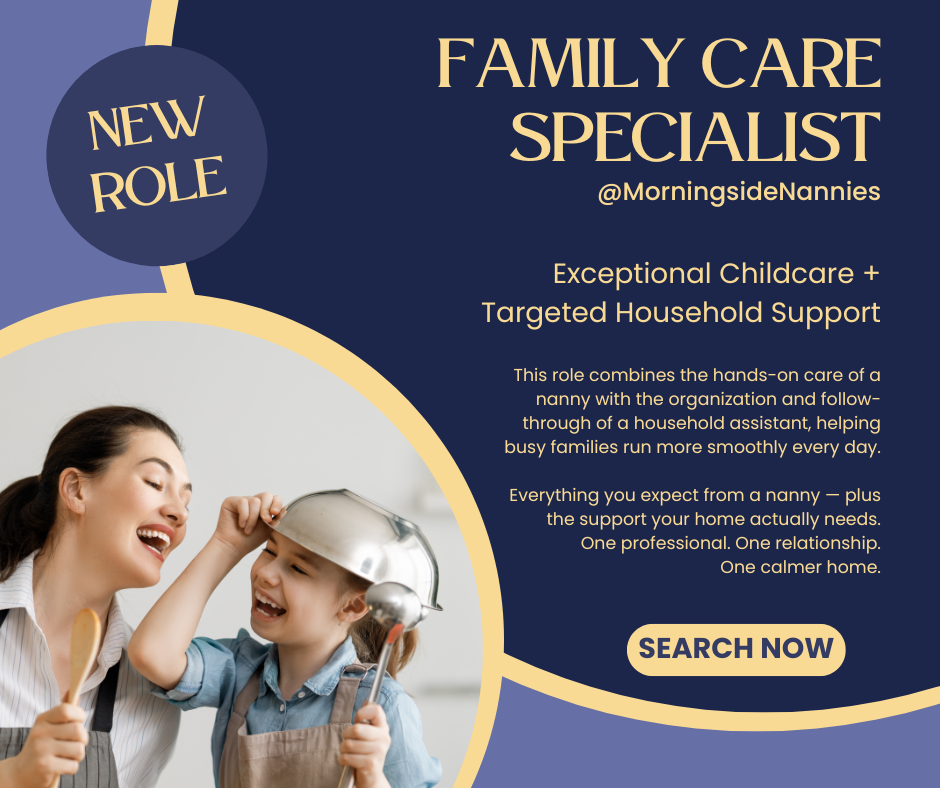
A Family Support Specialist provides exceptional childcare and practical household support — all in one trusted professional.
The Family Support Specialist role combines the hands-on care of a nanny with the organization and follow-through of a household assistant, helping busy families run more smoothly every day.
Everything you expect from a nanny — plus the support your home actually needs.
One professional. One relationship. One calmer home.
Family Support Specialist = Exceptional Childcare + Targeted Household Support
The Family Care Specialist always leads with childcare — this is what families trust first.
- Child safety, supervision, and development
- Age-appropriate play, routines, and enrichment
- School drop-off/pick-up coordination
- Child meals, snacks, and feeding routines
- Child laundry, organization, and spaces
- Communication with parents about daily care
- Childcare and safety is always prioritized.
Targeted Household Support
- Family meal prep (simple, weekday-friendly)
- Grocery ordering and pantry resets
- Child-related errands & light family errands
- Dish resets and kitchen tidying
- Family calendar coordination
- Managing vendors related to children (tutors, activities, carpool coordination)
- Light household organization (entryways, backpacks, family command centers)
- Not deep cleaning. Not a housekeeper. Not unlimited.
Your Partner in Family Life — Not Just Another Helper
Professional childcare plus practical home support for busy dual-career families in Houston.
Email info@MorningsideNannies.com or call (713) 526-3989 to learn more.
Posted in
Advice for Parents,
All About Nannies |
Comments Off on New Role: Family Support Specialist

The nanny industry is no stranger to change — but as we head into 2026, the shifts we’re seeing are deeper, more structural, and more permanent than ever before. Post-pandemic parenting, evolving workplace norms, and a more empowered caregiver workforce have reshaped what nanny jobs look like across the country.
Recent coverage out of New York City has highlighted six-figure nanny salaries and highly negotiated contracts, while other reporting has surfaced a growing sense of burnout and frustration among caregivers who feel stretched too thin. Both realities can exist at the same time — and they do.
Here are five key changes we will continue to see shaping nanny jobs in 2026:
1. Nanny Roles Are More Professional — and More Polarized
At the top of the market, nannying has become a highly compensated, professionalized career. These roles often include guaranteed hours, benefits, bonuses, and clear scopes of responsibility. At the same time, we are seeing increased strain in roles where expectations are unclear, compensation doesn’t match demands, or boundaries aren’t respected. The gap between well-structured positions and poorly defined ones is widening.
2. Nannies Are More Informed and Confident Negotiators
Today’s nannies are far more educated about their value, labor rights, and market conditions. They are asking smart questions, advocating for guarantees, and declining roles that don’t align with their needs. This isn’t entitlement — it’s professionalism. In 2026, successful placements will depend on transparency and mutual respect from the start.
3. Parental Expectations Have Intensified
Modern parents are deeply invested in their children — sometimes to a fault. With many parents working from home, nannies are navigating increased oversight, micromanagement, and pressure to perform multiple roles at once. Families who succeed with long-term nanny relationships are those who treat their nanny as a trusted partner, not an extension of themselves.
4. Burnout Is Driving Higher Turnover
While wages have stabilized in many markets, job demands have not. Long hours, emotional labor, lack of autonomy, and unclear boundaries are causing some experienced nannies to leave the profession altogether. In 2026, retention will matter more than recruitment — and that means sustainable schedules, realistic expectations, and respect for work-life balance.
5. Specialization and Skill Sets Matter More Than Ever
Families are increasingly seeking nannies with specific expertise — newborn care, developmental knowledge, educational backgrounds, or flexibility for travel and unconventional schedules. These specialized roles command higher compensation, but they also require clearer contracts and a shared understanding of scope. “All-in-one” jobs without structure are becoming harder to fill.
Nannying in 2026 is no longer a one-size-fits-all profession. The best outcomes happen when families approach hiring thoughtfully and nannies are supported as professionals. When expectations are clear, compensation is fair, and respect runs both ways, nanny placements don’t just work — they thrive.
As an industry, our opportunity moving forward is to raise standards on both sides of the relationship — not just in pay, but in communication, boundaries, and long-term sustainability.
Posted in
Advice for Nannies,
Advice for Parents,
All About Nannies |
Comments Off on How Nanny Jobs Are Changing in 2026
In 2026, the nanny tax threshold will increase to $3,000, up from $2,800 in 2025. This means families who employ a nanny and pay them $3,000 or more in a calendar year are required to comply with household employment tax obligations, including paying Social Security and Medicare taxes, as well as potentially state unemployment insurance.
For nannies, this ensures contributions toward their future benefits and safeguards their rights as employees. Employers should update payroll systems and consult a tax professional if necessary to ensure compliance with federal and state laws. Both parties benefit from maintaining a transparent, legal employment relationship.
The IRS has announced the standard mileage rates for 2026. The rate for business use of a personal vehicle will increase to 72.5 cents per mile for 2026, up from 70 cents in 2025. Nanny employers often use the business mileage rate to reimburse employees for work-related vehicle use.
Posted in
Uncategorized |
Comments Off on 2026 Nanny Tax Updates
 Houston Nanny Trends for 2025–2026
What Families and Nannies Should Know This Year-End
As we wrap up 2025 and look ahead to 2026, the Houston nanny market continues to evolve — driven by shifting family needs, competitive pay expectations, and an increased focus on professional growth and retention.
What’s Shaping the Houston Nanny Market
Demand for Skilled, Flexible Nannies is Rising
Families in Houston are increasingly seeking nannies who can wear multiple hats — from infant care and school-age support to homework help and light household tasks. Nannies with specialized skills (early childhood education, special needs experience, bilingual fluency) are especially in demand.
Professional Development Matters
Both families and nannies are prioritizing ongoing training. CPR/First Aid, age-specific development courses, and enrichment certifications are becoming standard expectations — and can justify higher pay.
Flexible Schedules + Work-Life Balance
Hybrid schedules, split shifts, and part-time roles are no longer fringe — they’re here to stay. Families aiming to attract top talent are offering more predictable hours and opportunities for schedule flexibility in 2026.
Stable Wage Expectations
After several years of rapid wage growth driven by the pandemic, Houston nanny wages have begun to stabilize. For 2025 heading into 2026, average pay is holding steady at approximately $24–26 gross per hour for full-time roles and $26+ per hour for part-time positions. Roles with fewer guaranteed hours, greater scheduling flexibility, specialized experience, or added non-childcare responsibilities continue to command higher wages than more traditional childcare-only positions.
Holiday & Year-End Bonuses + Raises
As we approach the holidays, it’s a great time for families to show appreciation — and for nannies to think strategically about compensation.
Holiday Bonuses
It’s customary (and deeply appreciated!) for Houston families to offer holiday bonuses to nannies.
A general guideline for 2025 holiday bonuses:
Full-time nannies: 1 to 2 week of pay
Part-time nannies: 1 to 2 week of pay
Long-term/elite caregivers: Bonuses above 1 week may be appropriate
A thoughtful bonus strengthens loyalty and acknowledges hard work — especially after a year of growth and flexibility.
Year-End Raises
With rising living costs in Houston and competitive demand, many families are considering year-end raises. Here’s what to keep in mind for 2026 planning:
Market review: Houston’s nanny market has seen wage increases year-over-year; consider matching or exceeding local benchmarks to retain top talent.
Performance & tenure: Raises tied to reliability, skill gains, and length of service encourage longevity.
Transparent conversations: Open dialogue about expectations and pay helps align goals for both families and caregivers.
Looking Ahead to 2026
Families preparing for the new year should prioritize clear communication about compensation, schedules, and professional goals. Nannies should also feel empowered to discuss raises and professional development opportunities during year-end reviews.
Houston’s nanny landscape in 2025–2026 rewards adaptability, continued training, and proactive compensation planning. By recognizing great performance with bonuses and thoughtful raises, families not only express gratitude but also invest in stability and quality care.
Posted in
Advice for Nannies,
All About Nannies |
Tagged
bonus,
nanny |
Comments Off on Houston Nanny Trends for 2025–2026
← Older posts